Monday, September 18, 2017
Era Report WAC - 9/22/17
According to the Geologic Time Scale, there are four major eras in history that shape Earth as we know it today. The Precambrian era is the first era that occurred on Earth. This era covers almost 90% of Earth's entire history. The beginning of the Precambrian era started with the formation of Earth 4.6 billion years ago and ended at the first sign of complex life about 540 million years ago. This era is divided into three eons. This includes the Hadean eon, the Archean eon, and the Proterozoic eon. The Hadean eon started when the planet first began to form as the Earth's core was building. The solar system was constructing within a cloud of dust and gas, known as the solar nebula. The Archean eon was a time of continental building and showed the first stages of early life on Earth. At this time, the Earth's crust cooled enough that rocks and continental plates began to configure. The final eon apart of the Precambrian era is the Proterozoic eon. During the Proterozoic eon, life began to evolve into more complex organisms.
Since the Earth was barely formed during the Precambrian era, there were little to no plants present during this time. According to the Penn State University department of science, Lichens are believed to have been the first fungi existing on Earth. A Lichen is a composite organism that arises from algae cyanobacteria living among filaments of multiple fungi in a symbiotic relationship. During the Proterozoic eon of the Precambrian era, Lichens teamed up with photosynthesizing organisms. The organisms that Lichens collaborated with, include cyanobacteria and green algae. Together these plants conceivably boosted oxygen levels in the atmosphere high enough for animals to develop skeletons, grow larger, and diversify.
Toward the end of the Precambrian era, the first life formed. The first one-celled organisms formed during the Archean eon of the Precambrian era. Early evidence of life that was once living in the oceans of Earth were microscopic bacteria that were capable of photosynthesis. These one-celled organisms helped make the air and water around Earth become full of oxygen. Once there was plenty of oxygen in the atmosphere and in the ocean, new life could form. New varieties of bacteria began to harness the power of the sun through the biochemical process known as photosynthesis. This energy source ultimately lead to the creation of simple plants and opened the planet up to animal life. The Precambrian era ended with the emergence of complex, multi celled life forms. By the end of the Archean eon, the ocean floor was covered in a living mat of bacterial life.
Scientists named this eon after the Greek god Hades, who ruled underworld. The surface of the Earth during most of the Hadean eon must have been like our image of the underworld. During the Hadean eon the Earth released tremendous amounts of heat as the Earth's core was forming, due to gravitational sinking. In fact the surface temperature of Earth at this time, was at 1200 degrees Celsius. Throughout the Archean eon, the outer covering of the Earth cooled and hardened into a crust. The hot molten leaked out at weak places in the crust, creating volcanoes. Water from comets and hydrated minerals condensed in the atmosphere and fell as torrential rain. This rainfall formed and filled oceans. The presence of micro organisms on Earth during this time, indicates that 4 billion years ago the Earth's surface temperature must have cooled to less than 100 degrees Celsius. Furthermore, the oceans must have been above 0 degrees Celsius. Therefore, the Earth's surface temperature was between 0 degrees Celsius and 100 degrees Celsius. These temperatures would have had to occur on Earth during this eon in order for these organisms to have lived.
The basis of Earth's growth happened during the Precambrian era. There are three eons that make up the Precambrian era, including the Hadean, the Archean, and the Proterozoic. The Earth had just formed during the Hadean. At scorching temperatures, there were an abundance of radioactive elements and collisions with other solar system bodies. Approximately 70% of continental landmass was formed during the Archean eon. Huge pieces of crust began to move in different directions, called tectonic plates. This tectonic activity formed the first continent, Rhodinia, about 1.1 billion years ago. The modern-day continents South America, Australia, and Antarctica surrounded North America which was located in the middle. The Earth's crust started to cool down to between 0 degrees to 100 degrees Celsius for micro-organisms to live. However, the Proterozoic was the time when life actually evolved into more complex organisms. These organisms include bacteria life and multi celled organisms such as the Lichen fungi. All of these events that have occurred billions of years ago, are components that form the Earth we live on today.

Saturday, September 16, 2017
The Precambrian Era - 9/17/17

S&EP - SP6: Constructing explanations and designing solutions
I evaluated information to explain the history of the Precambrian era and form hypotheses. In order to complete the worksheet for this project, much research was required. I needed to search the internet to figure out when the Precambrian era began and when it ended, how long it lasted, the different periods it is divided into, the major events that occurred during the era and its different periods, the climate during this era, the positions of the continents during this period, what types of life lived during this era, and finally the major types of plants present in this era. Once finding the information for each of these topics, I answered the questions on the worksheet using detailed ACE explanations. I constructed an explanation of each topic I researched for the Precambrian era, when I found the needed information by searching sources online and collecting the information using the ACE structure of answering. I designed a solution to a problem when a source I was searching didn't have enough information needed to answer the topic questions. However I solved this problem by researching multiple sources to grasp as much information as I could find on the topic. For example, one website I visited didn't mention anything about plants existing during the Precambrian era. But after researching multiple websites, I finally found a website that gave me all the information I needed on the plants that lived during this era.
Friday, September 8, 2017
The Age of Rocks - 9/10/17
 |
| https://upload.wikimedia.org/wikipedia/commons/thumb/a/a0/Cross-section_of_sedimentary_layers.png/500px-Cross-section_of_sedimentary_layers.png |
S&EP - SP7: Engaging in argument from evidence
I use evidence to defend my explanation. I took notes on the age of rocks and fossils providing the power point about how scientists find the age of fossils, as evidence. I formulated evidence based on solid data when I stated that the top layer of rock is younger than the bottom layer of rock, using the fact that the older the rock is, the deeper it is in the ground as evidence. I examined my own understanding in light of the evidence. I used to think that rocks were dated depending on what stage of the Rock Cycle they were in, but because of understanding the information on the power point that my teacher presented in class, now I think that rocks are dated by their layers. I collaborated with my peers in searching for the best explanation. I did some research on the age of rocks and fossils which I discussed with my class and table group. Together we figured out that scientists find the age of fossils depending on how deep the rock is in the ground.
Thursday, August 31, 2017
The Rock Cycle - 9/2/17
 |
| http://www.mineralogy4kids.org/sites/default/files/rockCycle_0.jpg |
S&EP - SP1: Asking questions and defining problems
I formulated testable questions when I discovered what I needed to do in order to complete the worksheet I did in class, about the Rock Cycle. I established what is already known about the Rock Cycle by writing, filling out, and answering questions about the Rock Cycle and how it works, using the online Gizmo. I determined what questions have yet to be answered when I looked back on the information that I collected and saw which of the questions on the worksheet I still needed to answer. I defined constraints and specifications for a solution when I noticed that some of the information on the worksheet I needed to have wasn't actually on the Gizmo. This information that I needed should only be answered by myself, since it was only the basic knowledge of the Rock Cycle I should have. However, I had some trouble on this part because the Rock Cycle is review from sixth grade and I don't quite remember all the processes of the cycle.
Sunday, May 21, 2017
The Environmental Accords 5/21
 |
| http://ueamelakasummit2017.mpag.gov.my:8081/uea/uea/images/logo_uea.png |
S&EP - SP7: Engaging in argument through evidence
I used evidence to defend my explanation. I created a brochure for my Redesigned Urban Village using the Urban Environmental Accords, providing three Urban Environmental Accords as evidence. For this assignment, I had to create a brochure type document for my Urban Village. I chose three Environmental Accords and listed them down on my brochure. As well as I wrote a paragraph for each of the three Environmental Accords, stating how my Urban Village will reflect and show these Accords in its environment. I formulated evidence based on solid data when I stated that my Urban Village will provide a compost bin and a recycling bin next to every trash can following Environmental Accord #6 using the fact that Accord #6 is to implement "user-friendly" composting and recycling programs as evidence. I examined my own understanding in light of the evidence. I used to think that the 21 Urban Environmental Accords were just about helping to protect the environment generally, but because of reading through the different Environmental Accords for this assignment, now I think that the Urban Environmental Accords are separated by seven specific categories Energy, Waste Reduction, Urban Design, Urban Nature, Transportation, Environmental Health, and Water. I collaborated with my peers in searching for the best explanation. I did some research on the 21 Urban Environmental Accords which I discussed with my table group and elbow partner. Together we figured out all of the different 21 Urban Environmental Accords and how they impact the environment of an Urban Village.
XCC: Cause and Effect
The cause and effect relationship that occurs in the 21 Environmental Accords happens between the specific accord and how it impacts the environment of an Urban Village. The actions of one of the Environmental Accords effects the environment by improving energy, waste reduction, urban design, urban nature, transportation, environmental health, and water. As well as the outcome of each of the Urban Environmental Accords not only benefits the environment, it also impacts an Urban Village by improving quality of life. For example, action #13 is to develop and implement a policy which expands affordable public transportation coverage to within half-a-kilometer of all city residents in ten years. This impacts the environment by encouraging more public transportation to reduce the amount of fossil fuels that are released by individual cars. Less fossil fuels released into the atmosphere, means less pollution in the environment. As well as this action also helps the Urban Village by providing a more affordable public transportation system to the community.
Sunday, May 14, 2017
The Different "Spheres" of the World 5/14
 |
| http://assets.openstudy.com/updates/attachments/547f6731e4b03e22bc88fba0-kamibug-1417635919362-capture.png |
S&EP - SP7: Engaging in argument through evidence
I used evidence to defend my explanation. I played a playlist of educational games on "Legends of Learning" that dealt with human impact on the Earth and taught me how we can start improving, providing the information that I learned as evidence. I formulated evidence based on solid data when I stated that human activities damage the atmosphere by creating air pollution using my knowledge that gas emissions from transportation mobiles, fossil fuel gases that are given off from human made factories, and smoke that is burned from humans cause air pollution, as evidence. I examined my own understanding in light of the evidence. I used to think that deforestation of areas in order to clear space for cities effected the lithosphere most because of soil erosion that deforestation causes, but because of playing the educational games and learning new information, now I think that deforestation is a huge impact on the biosphere because of the lost of homes of animal species. I collaborated with my peers in searching for the best explanation. I did some research on the different "spheres" of the Earth and how human activities greatly impact them, which I discussed with my class and the people at my table. Together we figured out how humans effect the environment of the Earth and the Earth's "spheres" with our actions.
XCC: Cause and Effect
The cause and effect relationship that occurs in the different "spheres" of the Earth happens between us humans and the well being of the Earth's environment. More specifically, the relationship revolves around the actions and activities humans take in daily life and how this effects the "spheres" of the Earth. For example when humans let out fossil fuels into the atmosphere, this not only affects the atmosphere with air pollution, it also causes the global warming. Global warming is the act of the Earth getting warmer. When the Earth gets warmer, it effects the cryosphere by melting ice. This is important because when the ice melts, it effects the entire planet's energy balance and encourages global warming. Another example of this relationship is when humans cause water polution. When we release oil, trash, and other toxic items into bodies of water, it of course pollutes the water and contaminates it. However, this action also affects the biosphere by killing any species that live in these contaminated bodies of water.
Sunday, May 7, 2017
Acid vs. Base 5/7
 |
| http://www.differencebetween.info/sites/default/files/images/1/ph-scale.jpg |
S&EP - SP7: Engaging in argument from evidence
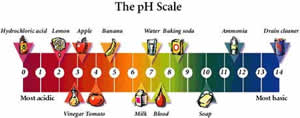
I used evidence to defend my explanation. I conducted an experiment that tested the pH level of different acidic or basic products and filled out a worksheet about the pH level of acids and bases, providing the results of the experiment as evidence. I formulated evidence based on solid data when I stated that the more red the substance was when it was tested, the more concentrated the acid was using my observation that the lower the numbers got on the pH scale, the more red the substance had to be and the lower the pH level of a substance means that the substance is a stronger acid, as evidence. I examined my own understanding in light of the evidence. I used to think that when a substance had a pH level of 7, it just meant the substance was in between and was both an acid and a base, but because of learning about neutral substances now I think that when the pH level of a substance is 7 that means that it is neither an acid or a base, but a neutral substance. I collaborated with my peers in searching for the best explanation. I did some research on how to use a pH scale to tell if a substance is an acid or a base which I discussed with my class and the people at my table who conducted the experiment with me. Together we figured out that the lower the pH level and the more red a substance is, the more acidic the substance is. As well as the higher the pH level and the more green or blue a substance is, the more basic the substance.
XCC: Patterns
The pattern that occurs with using a pH scale to measure if a substance is acidic or basic, deals with the pH level of the substance and what color it is when tested. I observed this pattern when conducting an experiment in class that allowed me to see how acidic or basic a substance was based on its pH level. During the experiment I saw that after testing out the substances, all the acid products were a pink to reddish color and all of the base products were a green to blue color. When testing an acid product, I noticed that the more red the substance, the lower the pH level of the substance. Which lead me to figure out the the lower the pH level of a substance, the stronger and more concentrated the acid is. As well as the higher the pH level of an acid, the weaker and less concentrated the acid is. In contrast, I noticed an opposite pattern with bases. When testing a base product, I noticed that the more green the substance got, the higher the pH level of the substance on a pH scale. With this information I found that the higher the pH level of a substance, the more concentrated and stronger the base is. In addition, the lower the pH level of a base, the less concentrated and weak the base is.
Subscribe to:
Posts (Atom)